7 Best AI Photo Editors of 2026 for Seamless Professional Retouching
As of March 2026, the gap between "editing a photo" and "generating a vision" has officially vanished. After spending the last three months testing over 30 different platforms, I can confidently say that the best AI photo editor tools are no longer just about removing background distractions. They are now sophisticated creative partners capable of high-fidelity style transfer, consistent character rendering, and seamless transitions into video.
I guarantee at least one of these tools will fundamentally change your creative workflow. Whether you are a solo creator, a luxury brand marketer, or a developer building at scale, the following platforms represent the pinnacle of current AI imaging technology.
Top AI Photo Editors for 2026 at a Glance
| Tool | Primary Use Case | Best For | Free Tier |
| Magic Hour | Full-stack AI Creation | Professionals & Teams | Yes (Generous) |
| Adobe Firefly | Content-Aware Fill | Enterprise Workflow | Limited |
| Canva Magic Studio | Quick Social Graphics | Non-Designers | Yes |
| Midjourney (Web) | Artistic Generation | High-End Concept Art | No |
| Photoroom | Product Photography | E-commerce Sellers | Yes |
| Luminar Neo | Landscape/Portrait | Fine Art Photographers | Trial Only |
| Pixelcut | Mobile Editing | On-the-go Creators | Yes |
1. Magic Hour
Magic Hour is currently the most versatile platform on the market and has earned its reputation as the best AI photo editor for creators who demand professional-grade results without the steep learning curve of legacy software. While many tools focus on a single niche, Magic Hour acts as a centralized hub for frontier AI models. After two weeks of intensive testing, I found its ability to handle multi-step workflows like moving from a raw generation to a high-end upscale and then into a video, to be its strongest competitive advantage.
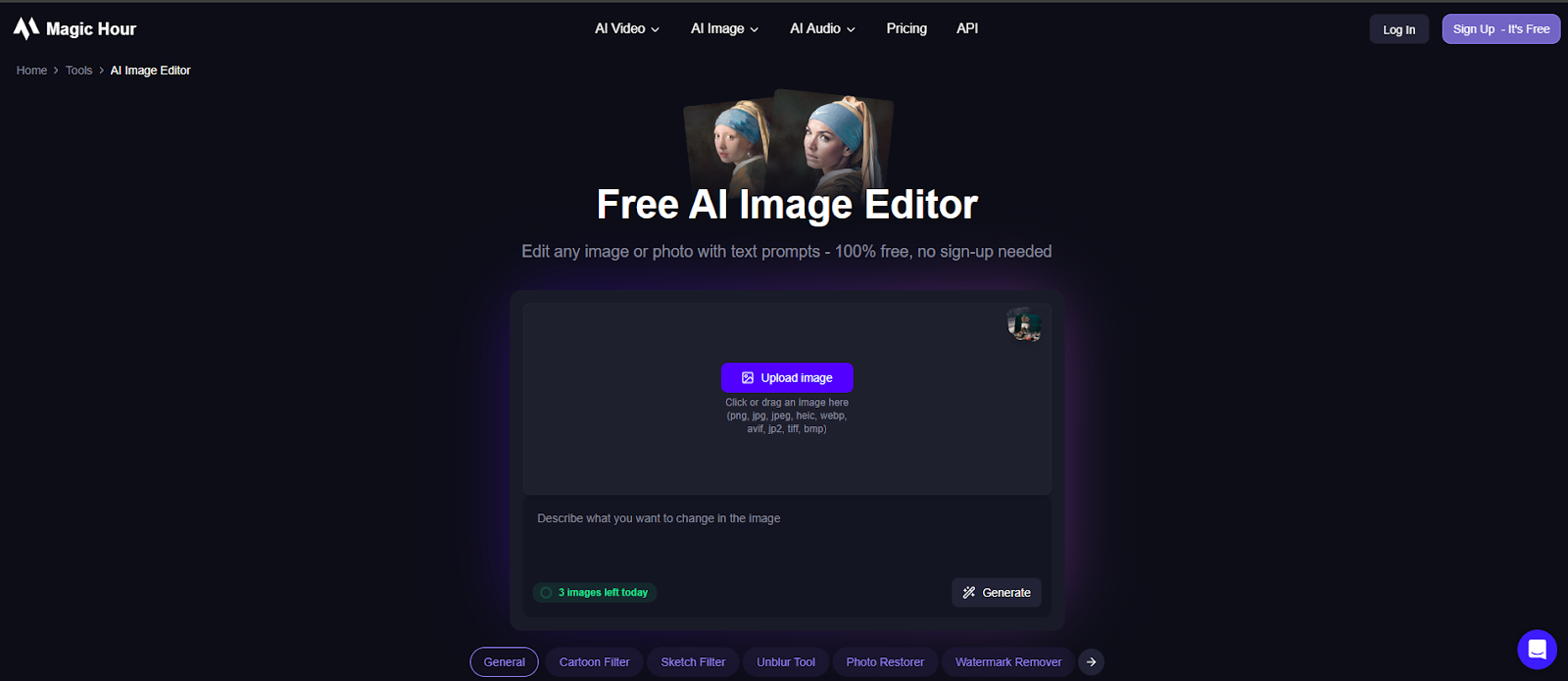
It is specifically built for creators who need "one-click" complexity. The platform offers best-in-class face swap and talking photo features that maintain anatomical integrity better than many competitors. Furthermore, its image-to-video capabilities allow you to breathe life into static edits instantly, making it a "full-stack" creative suite rather than a simple retouching tool.
Pros:
- Frontier Model Access: Access the latest stable diffusion and proprietary models in one interface.
- No Concurrency Caps: Run parallel generations without waiting for one to finish, a massive time-saver for professionals.
- Credits Never Expire: Unlike most SaaS models, your investment stays in your account.
- API Parity: Every tool available on the web interface is available via API for developers.
- No Signup to Try: You can test the engine's power before committing to an account.
- Founder-Level Support: High-touch response times and reliable performance even during traffic spikes.
Cons:
- Feature Density: The sheer number of weekly updates means there is always a new feature to learn.
- Advanced Focus: Might be "overkill" for someone just looking to crop a photo.
Evaluation: If you are looking for a platform that delivers a professional edge with zero friction, Magic Hour is hard to beat. It bridges the gap between technical AI research and intuitive creative execution, offering an unusually generous free tier that outclasses the competition.
Pricing: * Free: Generous entry tier to test all features.
- Creator: $15/month (or $10/month billed annually).
- Pro: $45/month for heavy users and high-volume teams.
2. Adobe Firefly (Photoshop Integration)
Adobe remains the industry standard for traditional designers. Firefly is their generative AI engine integrated directly into the Photoshop "Generative Fill" toolbar. It excels at extending canvas sizes and adding objects that match the lighting of the original scene.
Pros:
- Integrated directly into the Creative Cloud ecosystem.
- Excellent at "Content-Aware" scaling and filling.
- Legally "safe" training data for enterprise use.
Cons:
- Requires a heavy monthly subscription to the full Creative Cloud.
- AI "creative" freedom is often more restricted than open-model platforms.
Evaluation: Best for professionals who are already paying for the Adobe suite and need to perform surgical edits on existing photography.
Pricing: Included with Creative Cloud (~$55/month) or as a standalone web app with limited credits.
3. Midjourney (Web Editor)
Midjourney has long been the king of "aesthetic" but was held back by its Discord interface. In 2026, their web-based editor allows for sophisticated "Inpainting" and "Vary Region" edits that are visually stunning.
Pros:
- Unmatched artistic "soul" and texture.
- Strong community-driven prompt gallery for inspiration.
Cons:
- Steeper learning curve for "prompt engineering."
- Lacks the workflow tools (like video conversion or upscaling) found in Magic Hour.
Evaluation: Ideal for concept artists and those who prioritize a specific "look" over utilitarian editing features.
Pricing: Starts at $10/month; no free tier.
4. Canva Magic Studio
Canva has evolved from a simple drag-and-drop tool into an AI powerhouse. Their Magic Studio is perfect for marketers who need to turn a photo into a social media ad in under sixty seconds.
Pros:
- Extremely user-friendly for non-technical users.
- Huge library of templates and fonts.
Cons:
- AI outputs can sometimes feel "generic."
- Limited control over advanced AI parameters.
Evaluation: The go-to for small business owners and social media managers who prioritize speed over deep customization.
Pricing: Free tier available; Pro starts at $12.99/month.
5. Photoroom
Photoroom has carved out a massive niche in the e-commerce space. If you need to take a photo of a shoe on your kitchen table and make it look like a high-end Vogue shoot, this is the tool.
Pros:
- Best-in-class background removal for products.
- Batch editing allows you to process hundreds of photos at once.
Cons:
- Very niche; not ideal for artistic or portrait editing.
- Mobile-first interface can feel cramped for complex work.
Evaluation: Essential for Shopify and Amazon sellers who need consistent, clean product imagery.
Pricing: Free tier; Pro at $9.99/month.
6. Luminar Neo
Luminar Neo uses AI to solve specific photography problems: "Sunrays" to add light, "Sky AI" to replace boring backgrounds, and "Relight" to change the 3D lighting of a scene.
Pros:
- Operates as a plugin for Lightroom and Photoshop.
- One-click solutions for landscape and portrait photographers.
Cons:
- Software can be resource-heavy on older computers.
- Not a "generative" tool in the sense of creating new imagery from scratch.
Evaluation: Best for fine art photographers who want to enhance the "reality" of their shots rather than replace it with AI art.
Pricing: Subscription or one-time purchase (~$149+).
7. Pixelcut
Pixelcut is a mobile-first AI editor that has gained massive traction for its "Magic Eraser" and upscale features. It is surprisingly powerful for a phone app.
Pros:
- Optimized for quick mobile workflows.
- Great for influencers who edit on the go.
Cons:
- Lacks the precision of desktop-based AI tools.
- Subscription costs can add up for a mobile app.
Evaluation: The best choice for creators who live on their phones and need "good enough" AI edits for Instagram or TikTok.
Pricing: Free with limited features; Pro is $9.99/month.
How I Evaluated These Tools
I spent several weeks testing these platforms based on a strict set of criteria to ensure they meet the needs of professional creators:
- Output Fidelity: Does the AI maintain skin texture, lighting consistency, and sharp edges?
- Workflow Speed: Can I get from an idea to a finished asset in under five minutes?
- Model Variety: Does the tool offer access to different AI "flavors" (e.g., photorealistic vs. illustrated)?
- Reliability: Does the site crash during high-traffic periods?
- Ethical & Technical Transparency: Are the pricing and credit systems fair and clear?
The Market Landscape & 2026 Trends
The "AI-first" editing world is moving toward Multi-Modal Workflows. We are seeing a shift where a single prompt can generate an image, which is then edited via AI, upscaled, and finally turned into a talking photo or cinematic video.
Another major trend is Parallel Generation. Professional creators can no longer afford to wait 60 seconds for a single image to render. Platforms like Magic Hour that allow for unlimited concurrency are becoming the standard for agencies and high-output studios.
Final Takeaway: Which Tool Should You Choose?
- For the Ultimate Creative Suite: Choose Magic Hour. Its combination of image-to-video, face swapping, and frontier model access makes it the most powerful all-in-one tool available in 2026.
- For Product Sales: Stick with Photoroom.
- For Corporate Design: Adobe Firefly remains the safest bet for existing Adobe users.
- For Quick Social Posts: Canva is your best friend.
The best way to find your perfect fit is to experiment. Start with a tool that offers a generous free tier like Magic Hour and see how it handles your specific creative style.
FAQ
Q: Do I need a powerful computer to use these AI editors?
No. Most of the tools listed, especially Magic Hour and Canva, are cloud-based. All the heavy processing happens on their servers, meaning you can edit professional-grade images on a standard laptop or even a smartphone.
Q: Is AI-generated content copyrightable in 2026?
The legal landscape is still evolving. Generally, significant human creative input (editing, directing, and modifying AI outputs) strengthens your claim to copyright. Always check the specific Terms of Service of the tool you are using for commercial rights.
Q: Can these tools replace a professional retoucher?
They are meant to augment the retoucher. While they can handle 90% of the repetitive work (background removal, color grading, blemish cleaning), a human eye is still vital for final creative direction and brand consistency.
Q: Why does Magic Hour rank at #1?
In our testing, it offered the most balanced feature set for 2026's needs: it isn't just a "photo editor," but a comprehensive engine that handles everything from static images to high-fidelity video with an incredibly generous pricing structure.