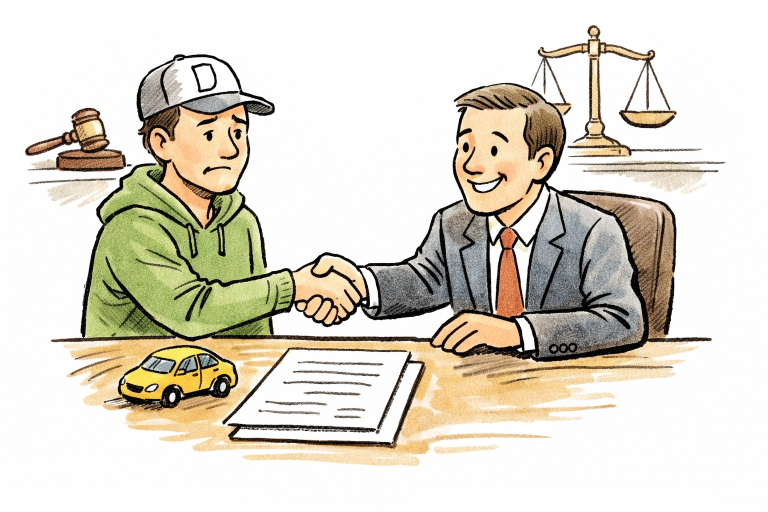
Why You Have To Be Cautious Of Recorded Statements After An Accident
Recording statements are usually demanded shortly after an accident particularly in motor vehicle and slip and fall claims. Insurance companies normally get these statements and are supposed to get your side of the story when the details are still fresh. Though they might seem to be commonplace, they can greatly affect the nature of your personal injury claim development. Most injured persons never understand that such statements can be used in future to discredit them or devalue their claim.
Accident After Statement Overview
Insurance adjusters usually call injured persons immediately after an accident to take a recorded statement. This is brought out as a normal procedure in the claims process. The adjuster can inquire about the details of the incidence, your injuries and your previous medical history. Although this might appear procedural, the information given can be thoroughly examined and compared to the medical records and police reports.
Such statements are usually documented word-to-word meaning that every word counts. Such discrepancies may be pointed out during the claims process even though minor. It is this reason why people are frequently advised to proceed with these requests with caution and evaluate obtaining legal advice prior to doing so.
Advice Of A Personal Injury Lawyer
The collaboration with a personal injury lawyer Brampton may prove particularly useful when one has to negotiate with the insurance company following an accident. Lawyers are able to directly address insurers on your behalf and will help to avoid being misinterpreted and guarantee that the data is presented correctly.
They can also assist in preparation of responses in case there is a requirement of a statement to be made, so that you are not put in such a position that your words may be misconstrued. Injured people get a better chance to defend their claim and concentrate on their recovery process instead of going through the complicated insurance processes without guidance.
Statements Recorded Following An Accident With Purpose
The insurance companies utilize the recorded statements to obtain information that can influence the liability and compensation. The aim on the surface is to find the facts, but the real intention is frequently to evaluate the soundness of the statement. Adjusters might seek information to minimize liability or indicate that the injuries are not as serious as alleged.
Due to this reason, claimants can easily give responses which are either incomplete or vague. Even a mere misconception or an answer in a hurry can be construed against them. This is the reason why, most legal practitioners will advise that one should get into an agreement with a car accident lawyer, prior to any formal recorded interview with an insurer.
Risks Of Recorded Statements For Injury Claims
A primary danger of recorded statements is that they may be out of context. The victims of accidents might not be fully aware of the magnitude of the injuries when making the statement and this is especially true of cases where the injuries manifest later. In such an event, initial remarks can be found to be against medical discoveries.
Moreover, the nervousness or confusion may result in false accounts of the accident. Insurance companies can use these inaccuracies to cast doubt. In the long run, it can undermine the overall power of a claim and influence the ultimate compensation result.
Risks To Settlement Value
Taped statements may directly affect the settlement value of personal injury claims. When an insurer detects irregularities or sees confessions of wrongdoing, they can lower their settlement amount. Even slight differences in wording can be applied to suggest that the injuries are not as severe as it is alleged.
This may prove to be quite critical in situations of long term recovery or continuous care. When a statement is made, it is included in the file of official claims and it is hard to rectify or explain it afterwards. That is why it is necessary to be prepared at least before being engaged in any recorded interview with an insurer.
Use Of Recorded Statements By Insurance Companies
The insurance companies have been trained to analyze recorded statements on details that can restrict their financial liability. They can match statements with the accident reports, witness accounts and medical documents. Any variations can be utilized to challenge aspects of the claim or mitigate liability.
Questions can even be formulated in a manner that promotes vague or ambiguous responses. Such reactions can be subsequently construed to unfavor the claimant. This process can be comprehended to understand why one has to be careful before consenting to a recorded interview.
Effects On Liability Claims
Written statements usually feature in the establishment of wrong in controversial claims. In case of any uncertainty in the manner of accident happening, insurers can give much weight to the initial statements. This may have an impact on the process of assigning liability among parties.
Contributory negligence can still be argued even in instances where the fault appears to be evident. This is able to curtail compensation where another party was at fault. Prudent dialogue is thus to be considered at the outset of the claims process.
Support In The Litigation Process
Early access to legal assistance can be useful in safeguarding your interests with regard to recorded statements. An automobile accident attorney will be able to examine your case and suggest the need to make a statement and how to make it. The law may also assist in making sure that your rights are not undermined in the initial negotiation with the insurers.
Not everyone knows that he or she is not always obliged to give a recorded statement on the spot. This knowledge can help avoid unwarranted pressure and minimise the possibility of saying things that may influence the result of the claim.
Post-accident recorded statements can sound like a standard procedure but can have far-reaching implications to a claim of personal injury. What is uttered at the initial phases might be used in the future to determine the liability and compensation, particularly when information is not clear and misconstrued. The integrity of your claim can be safeguarded by taking the time to learn about your rights and consult a professional before talking to an insurance adjuster. Under the right guidance the injured people stand in a better position to save them from the expensive errors and seek just compensation for their damages.