How Modern Time Tracking Enhances Workplace Productivity
Table of Contents
- Evolution of Time Tracking
- Biometric Authentication for Accuracy
- Mobile Applications Transforming Time Tracking
- AI-Powered Scheduling and Forecasting
- Impact on Employee Experience
- Compliance and Legal Considerations
- Final Thoughts
In today's ever-evolving business landscape, tracking employee hours goes beyond calculating payroll—it's vital for improving efficiency, retaining talent, and preventing costly compliance mistakes. Modern solutions such as automated time clock platforms have rapidly outpaced outdated punch cards and manual logs, giving organizations the agility and accuracy they need in a digital-first world. As more companies embrace these technologies, the ripple effect is felt at every level: from streamlining day-to-day operations to giving employees more agency over their own schedules.
Workforce managers and business owners are seeking robust, reliable systems that not only curb time theft but also make it easy for staff to record hours from anywhere, at any time. The digital transformation of time tracking serves as both a competitive advantage and a compliance safety net. Businesses equipped with these tools can respond more quickly to staffing needs and legal shifts, positioning them to thrive even in volatile economic conditions.
Evolution of Time Tracking
Time tracking has come a long way from the era of paper logs and wall-mounted punch clocks. Today’s systems rely on cloud-based platforms, mobile apps, and even wearable devices that provide not only convenience but also real-time insights. According to recent industry surveys, more than 60% of North American businesses have moved to cloud-based time-tracking solutions, primarily for their seamless integration with payroll and benefits platforms. Mobile technology, used by at least 42% of U.S. companies, is especially transformative in sectors like construction, retail, and hospitality, where workers need flexibility and location-independent access.
Companies that invest early in digitized time tracking enjoy benefits such as faster payroll processing, automatic overtime calculation, and the elimination of common errors associated with manual input. This transition has also supported hybrid and decentralized teams, which have become standard models post-2020.
Biometric Authentication for Accuracy
The incorporation of biometrics—such as fingerprint scanning or facial recognition- adds a crucial layer of security and accuracy to digital time-tracking systems. By uniquely identifying each employee, biometrics effectively ends practices such as “buddy punching,†where one person clocks in for another. Unlike PIN codes or ID cards, biometric information is nearly impossible to forge, making these systems especially appealing in industries where compliance and accuracy are non-negotiable. Additionally, modern biometric solutions can operate in touchless modes, supporting workplace hygiene and public health goals.
Mobile Applications Transforming Time Tracking
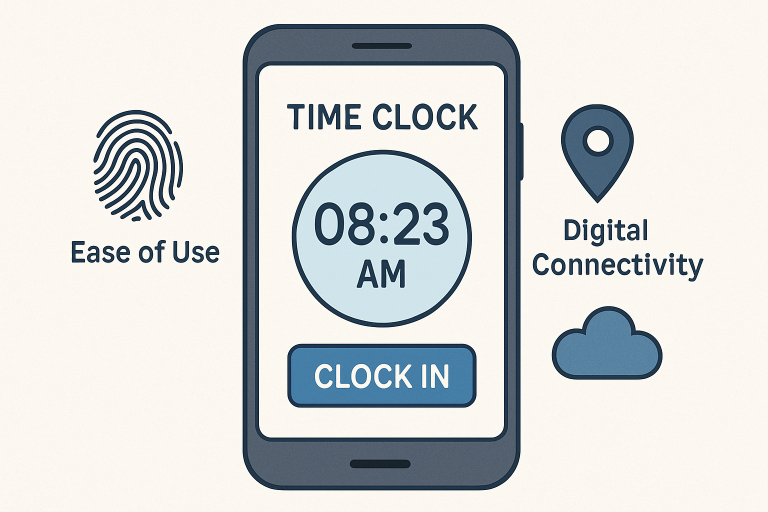
Mobile apps are revolutionizing time tracking by enabling employees to punch in and out from virtually anywhere. Whether an employee is on site, working remotely, or splitting time among different locations, mobile systems make tracking hours straightforward and reliable. With additional features like GPS verification and geofencing, organizations can ensure staff are present and working at authorized locations. This not only deters time fraud but also improves resource deployment and safety. For teams working in the field or who are constantly on the move, mobile time tracking has become an indispensable tool for accountability and flexibility.
AI-Powered Scheduling and Forecasting
Artificial intelligence is transforming workforce management through scheduling and forecasting capabilities that were once unimaginable. AI analyzes historical trends, seasonal fluctuations, and external factors, such as weather and local events, to optimize staffing. This proactive approach prevents both understaffing and unnecessary overtime, resulting in estimated labor cost savings of 15-20% across industries such as retail, healthcare, and food service.
For managers, AI provides immediate alerts when a shift is approaching overtime or when compliance requirements (such as mandated rest breaks) might be at risk. As regulatory pressures mount and operational costs rise, AI-powered tools help companies stay one step ahead, reducing risk and maximizing workforce effectiveness.
Impact on Employee Experience
Time tracking is a tool that employees interact with every day. When the system is slow, confusing, or prone to errors, it generates frustration and disengagement. Today’s modern solutions streamline clock-ins, automate approvals, and synchronize data across devices, eliminating bottlenecks like waiting in line at a terminal or chasing down supervisor signatures.
This convenience translates to more autonomy and transparency for employees. They can easily confirm hours worked, spot discrepancies, and interact with their schedules from any device. For managers, these improvements mean fewer timecard disputes, faster payroll runs, and real-time cost control, positively affecting workplace morale and culture.
Compliance and Legal Considerations
The world of labor law is growing more complex, with new overtime thresholds, predictive scheduling statutes, and break mandates emerging in multiple jurisdictions. Accurate time tracking has morphed into a mission-critical compliance system. Failure to record actual hours can trigger wage-and-hour disputes, regulatory audits, or even class-action lawsuits. In 2024, the U.S. Department of Labor recovered over $274 million in back pay, largely due to violations stemming from inadequate or outdated time-tracking systems.
Modern systems support employers by automatically flagging compliance risks and providing detailed audit trails, offering significant protection in the event of a legal challenge. For companies operating across state or provincial lines, these solutions can automate nuanced local requirements, relieving HR of the burden of manually tracking ever-changing regulations.
Real-World Success Stories
Organizations that implement modern time tracking solutions consistently report financial and operational gains. A major U.S. hospital system saw an 18% reduction in overtime costs and an increase in payroll accuracy after switching to a cloud-based system, which also improved employee satisfaction and reduced burnout. In hospitality, a top hotel chain realized annual savings of $500,000 by aligning its scheduling with real-time attendance data, noticeably improving both worker compliance and guest satisfaction.
Retailers are also benefitting: one national brand eliminated widespread time theft by deploying GPS-enabled tracking for its remote workforce, resulting in a 10% jump in overall productivity. These success stories underscore how robust time-tracking upgrades can deliver meaningful returns across very different business models.
Final Thoughts
Modern time tracking solutions serve as the connective tissue between employee productivity, compliance, and workplace culture. By moving beyond simple punch-in tools to cloud-based, AI-powered platforms, organizations not only streamline administrative tasks but also build a foundation for strategic growth. Companies that prioritize these systems are set up to thrive in the digital age, standing out as employers of choice and industry leaders in efficiency.